

Arc flash hazards are specific to the equipment and the way the electrical system is configured. Available fault current, protective-device clearing time, working distance, enclosure details, and operating condition all affect the result. A generic warning sticker cannot replace a study built from the facility's actual data.
Why an arc flash study matters
A useful study gives owners and qualified electrical workers the information needed to make better decisions before work begins:
- Understand the exposure. Incident energy and the arc flash boundary are calculated for each modeled equipment location and operating scenario.
- Plan electrical work. The results support energized-work planning, PPE selection, boundaries, and job briefings when energized work is justified.
- Find system problems. Short-circuit and equipment-duty analysis can identify breakers, fuses, switchgear, or other equipment with inadequate ratings.
- Reduce the hazard. Coordination and mitigation review can reveal practical setting or system changes that shorten clearing time or address other deficiencies.
- Give workers usable information. Final labels connect the approved analysis to the actual equipment in the field.
The labels are the field-facing result. The verified model and engineering report are what make those labels defensible.
When to commission or update a study
A facility should scope an initial study when current, equipment-specific results are not available. A review is also appropriate when:
- a new facility, expansion, BESS, solar system, generator, transformer, or major electrical asset is commissioned;
- utility service or available fault-current data changes;
- breakers, fuses, relays, trip units, or protective settings are changed;
- feeders, conductors, bus ties, switchgear, or system operating modes are modified;
- field conditions no longer match the existing one-line diagram or model; or
- the incident-energy analysis reaches its required accuracy review interval.
NFPA 70E calls for incident-energy analysis information to be reviewed for accuracy at intervals not exceeding five years. A material system change can make an earlier review necessary. Labels should be updated when the review finds that the existing information is no longer accurate.
What ETech does
1. Define the system and project basis
We establish the equipment boundary, available source records, operating scenarios, required calculations, label scope, owner deliverables, and any jurisdictional or professional-engineering requirements before field work begins.
2. Verify the electrical data on site
Qualified personnel document the as-built distribution system, including utility and transformer data, conductors, equipment nameplates, feeder paths, fuse and breaker details, relay or trip-unit settings, and equipment identifiers. Discrepancies and inaccessible information are logged instead of hidden behind assumptions.
3. Build and analyze the system in SKM Power*Tools
ETech uses SKM Power*Tools to build the power-system model and perform the project calculations. The scope can include short-circuit analysis, equipment-duty evaluation, protective-device coordination, and incident-energy calculations using the applicable IEEE 1584 method. The engineering review considers the calculations together because a protective-device change can affect safety, coordination, and equipment performance at the same time.
4. Quality-check and issue the final package
Equipment IDs, one-line references, model results, protective-device settings, and label values are reconciled before issue. The final package documents the basis of the study, unresolved conditions, findings, and recommended actions. For BESS, solar, and other sites with DC sources, the AC and DC scopes are identified clearly because different methods may apply.
What you receive
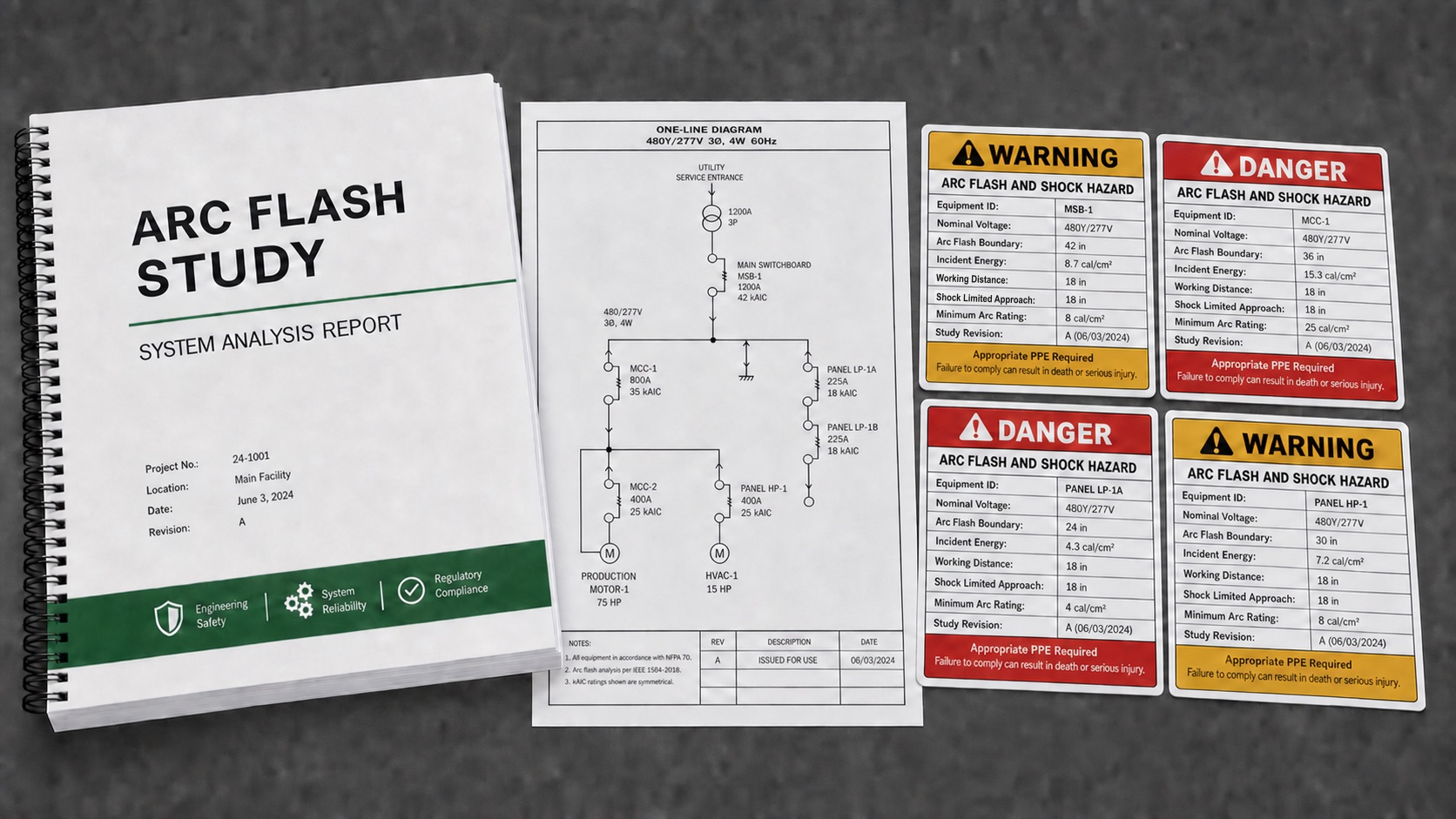
Complete engineering report
Study basis, assumptions, calculation results, equipment-duty findings, coordination information when included, incident-energy results, and recommended actions.
One-line diagram and system model
An updated electrical one-line tied to the modeled equipment, plus the agreed SKM model and digital source files for future updates.
Equipment-specific labels
Durable arc flash and shock hazard labels that match the final model, equipment IDs, working distances, and as-left protective-device settings. Printing and installation are defined in the project scope.
Prioritized mitigation plan
Clear separation of urgent safety or equipment-duty issues from setting changes, maintenance needs, and longer-term system improvements.
What appears on the equipment labels
Label content is selected for the facility's electrical safety program and applicable requirements. For equipment covered by NFPA 70E labeling provisions, the label includes nominal system voltage, the arc flash boundary, and the selected incident-energy or PPE information. A project label may also include the equipment ID, working distance, shock boundaries, minimum arc rating, study revision, and other site-specific information.
Labels are not interchangeable. Two pieces of 480-volt equipment can have very different exposure because their fault current and clearing times are different. Each issued label must stay tied to its equipment location and the approved study.
What the safety rules actually require
The requirements work together but are not identical. NEC 110.16 addresses arc flash hazard warning markings on specified electrical equipment in other-than-dwelling installations when that equipment is likely to be examined, adjusted, serviced, or maintained while energized. NFPA 70E provides the workplace framework for arc flash risk assessment, detailed equipment label information, safe work practices, and periodic review. IEEE 1584 provides calculation models used to predict incident energy and arc flash boundaries within its defined scope.
OSHA's electrical standards address deenergization, electrical safe work practices, PPE, alerting, and employee protection; OSHA does not publish one universal rule titled "arc flash study." The study supports an electrical safety program, but it does not replace qualified people, training, equipment maintenance, job planning, or establishing an electrically safe work condition whenever possible.
Questions to settle before work begins
- Which equipment and operating scenarios are included?
- Who will obtain utility data and verify field conditions?
- Does the scope include short-circuit, equipment-duty, and coordination analysis as well as incident energy?
- Will ETech supply labels, install them, or both?
- Will the owner receive the updated one-line, report, and SKM project files?
- Is PE review or stamping required by the owner, authority having jurisdiction, or project specification?
ETech engineering scopes are built around the facility. Send the latest one-line diagram, equipment list, site location, available utility data, and project objective. We will identify the field verification, analysis, labels, and engineering deliverables needed for a complete scope.