
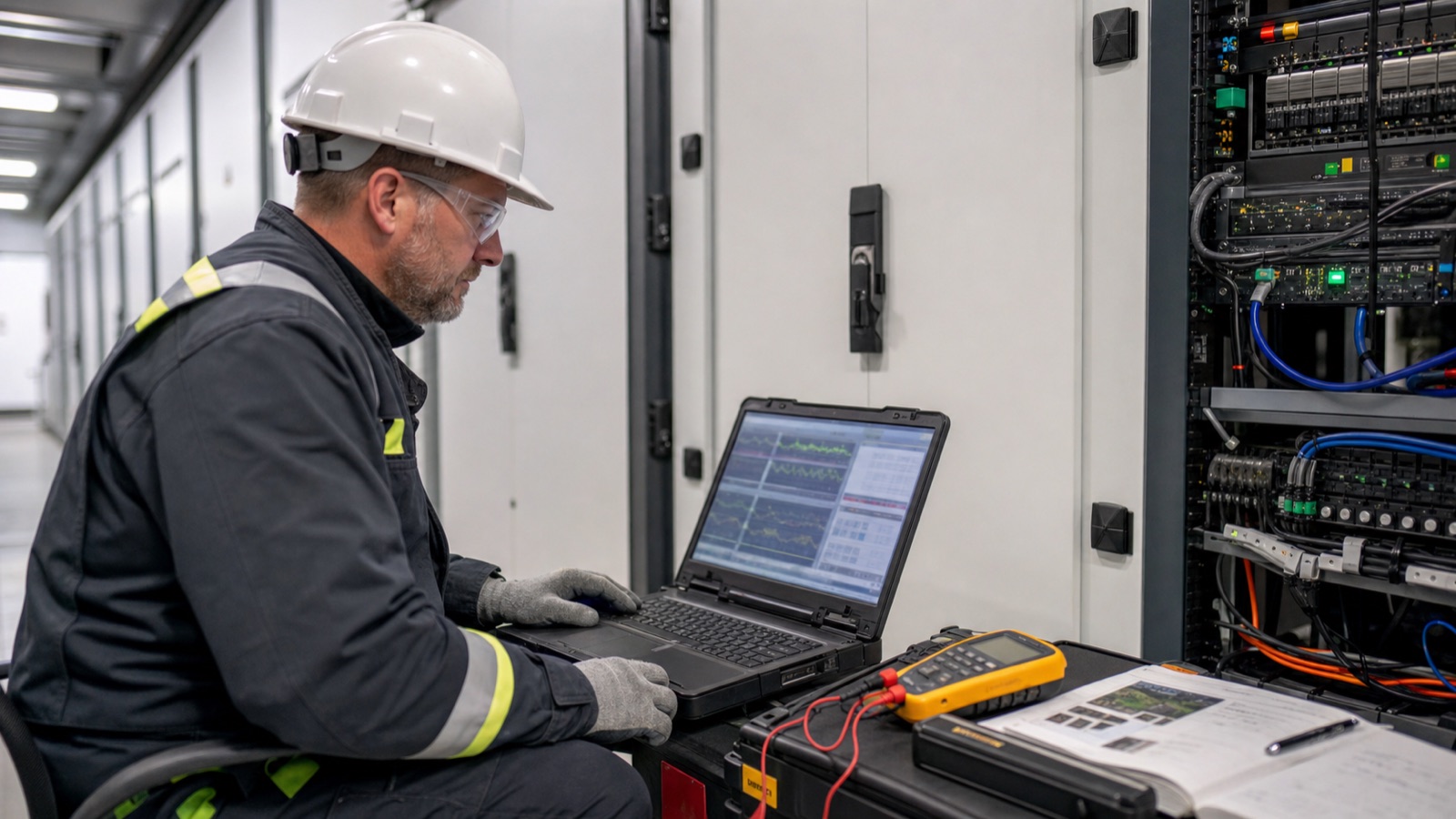
BESS faults cross several systems at once. A battery alarm can begin with cooling, auxiliary power, a drifting sensor, a network interruption, a protection event, or a real cell condition. Replacing the first component named in the alarm often clears the symptom without explaining the event. That is how repeat failures become expensive.
Preserve evidence before resetting anything
Resetting can erase the sequence that makes the failure understandable. Before changing state, capture:
- the first alarm, subsequent alarms, timestamps, and the timezone used by each system;
- power, state of charge, temperatures, voltages, currents, and auxiliary-system status before and after the event;
- the operating mode, dispatch command, weather, and any recent maintenance or software change;
- controller, BMS, PCS, EMS, HVAC, fire-system, and network logs that cover the same time window; and
- photos of equipment condition, indicator states, connections, contamination, moisture, or physical damage.
Synchronize the timeline first. Two devices can record the same event several minutes apart when clocks or timezones are wrong. A clean event sequence is often more valuable than another screenshot.
Build a fault tree, not a parts list
Start with categories that can explain the observed condition, then narrow them with evidence:
- Power path: source availability, fuses, breakers, contactors, control power, and grounding.
- Thermal path: airflow, cooling capacity, sensors, setpoints, condensate, and ambient conditions.
- Controls and communications: device status, network links, addressing, firmware compatibility, and command handoffs.
- Measurement: sensor plausibility, calibration, wiring, scaling, and channel mapping.
- Protection: the initiating condition, protective logic, clearing action, and any interlocks that prevented restart.
Test one hypothesis at a time. Record the expected result before the test, the actual result, and what that evidence rules in or out. This keeps troubleshooting from becoming a sequence of undocumented resets and component swaps.
Know when remote diagnosis has reached its limit
Remote data is valuable for triage and work planning, but it cannot confirm a loose terminal, blocked coil, water path, damaged connector, incorrect field setting, or failed actuator. Mobilize field support when the evidence requires a physical inspection, calibrated measurement, isolation, repair, or safe functional test.
Validate the repair under the condition that caused the fault
A cleared alarm is not the same as a verified repair. Validation should recreate the relevant operating condition as safely and practically as possible: load, temperature, command sequence, communication failover, or repeated cycle. Confirm that related systems behave normally and that the original symptom does not return.
What the field report should contain
- Executive finding: what failed, operational impact, current state, and required decision.
- Event timeline: first indication through restoration, with data sources identified.
- Evidence: photos, logs, measured values, inspection findings, and relevant equipment identifiers.
- Diagnostic path: hypotheses tested, results, and the confidence level behind the root-cause conclusion.
- Work performed: parts, settings, repairs, and as-left condition.
- Validation: the test used to confirm normal operation and the results observed.
- Open risk: temporary conditions, monitoring needs, recommended follow-up, owner, and due date.
Turn individual reports into fleet knowledge
Use consistent fault categories, equipment naming, severity levels, and closeout fields across sites. That structure makes repeat issues visible: a component family with rising failures, a seasonal cooling pattern, or a configuration problem introduced during a specific update. The report then becomes operating data, not a PDF that disappears into email.