
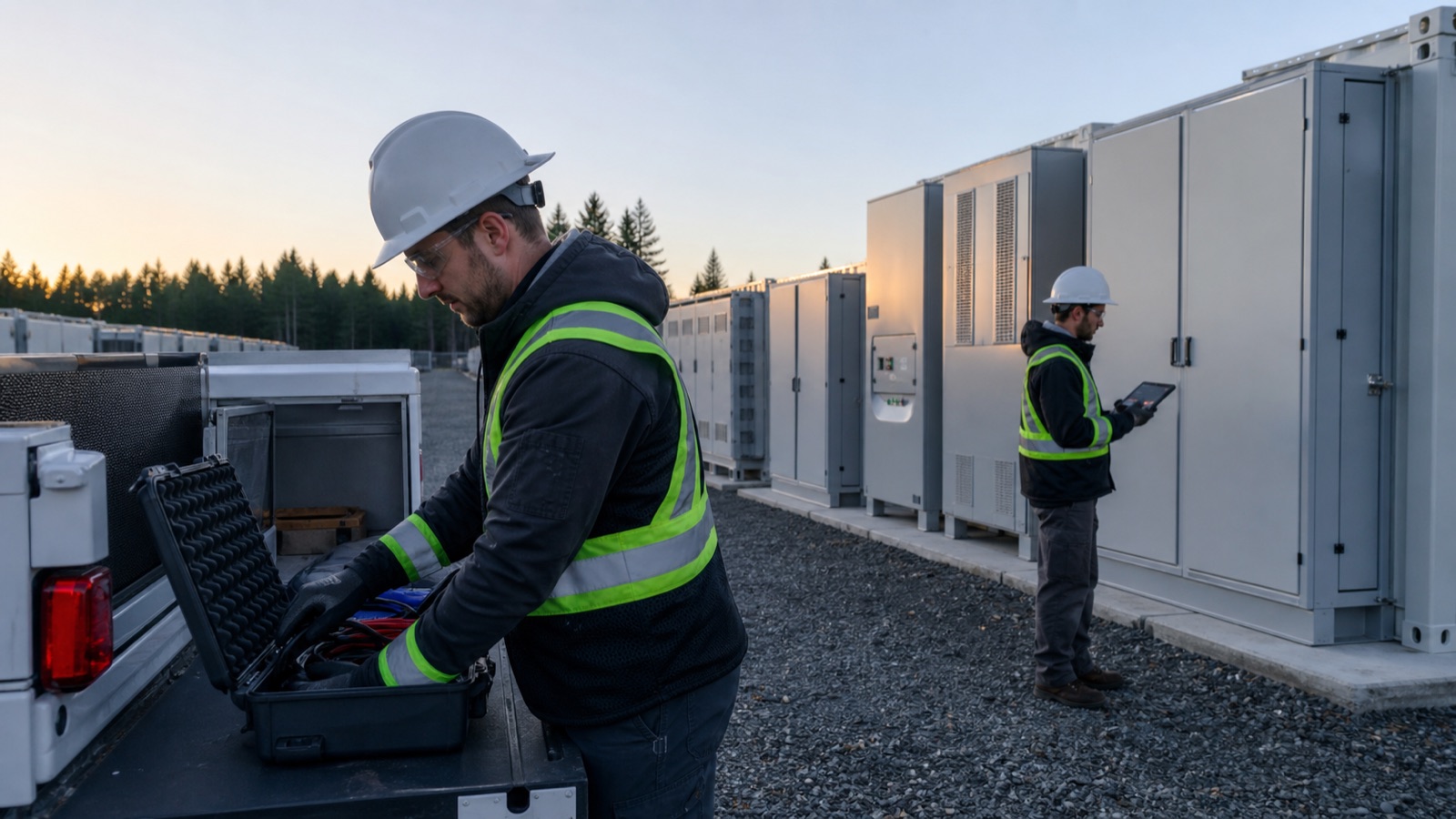
Rapid response is a controlled operating process, not simply a short travel time. The objective is to protect people, prevent the event from worsening, establish the cause, and return only the affected equipment to service after a defensible validation. Those steps begin before anyone enters the site.
Separate emergency response from equipment service
Reports of smoke, fire, venting, unusual odor, abnormal heat, damaged enclosures, or an active fire-system event require the site's emergency response plan and the appropriate emergency authority. A field service dispatch is not a substitute for emergency response. The owner should establish who controls the scene and when service personnel may approach.
The first question is not "How fast can someone open the cabinet?" It is "Who controls the site, what hazards are present, and what condition must be met before diagnostic work can begin?"
Build a useful dispatch package
The responding crew should receive a concise package before travel:
- site address, access instructions, escort requirements, and the person authorized to release equipment;
- the first alarm, current status, affected equipment, operating mode, and event timeline;
- recent trend data, logs, screenshots, photos, and any remote troubleshooting already performed;
- one-lines, equipment manuals, lockout/tagout procedures, arc-flash information, and known site hazards;
- OEM and controls contacts, warranty status, escalation authority, and limits on field changes; and
- likely tools, test equipment, PPE, consumables, and candidate spare parts.
Use remote triage to narrow the first field hour
Remote triage should identify what the event is and what it is not. Compare alarms across BMS, PCS, EMS, cooling, communications, fire, and auxiliary-power systems. Check whether the condition is isolated to one device or common to a feeder, network segment, environmental zone, or site-wide service. Preserve logs before resets change the evidence.
Start the site visit with a fresh safety gate
Conditions can change while the crew is traveling. On arrival, confirm scene control, complete the job briefing, inspect from a safe position, and verify the correct energy-control procedure before servicing. Stored electrical, mechanical, thermal, and auxiliary sources must be considered; an open breaker by itself does not prove an electrically safe state.
Recover in defined stages
- Stabilize. Prevent additional damage and maintain the safe boundary.
- Preserve. Capture the as-found condition, event evidence, settings, and physical observations.
- Diagnose. Test a fault tree instead of swapping unrelated components.
- Correct. Perform the approved repair, adjustment, or replacement and document the as-left state.
- Validate. Test the repaired function and related interlocks under an agreed operating condition.
- Release. Return equipment through the owner's switching, clearance, and operating process.
Communicate on a predictable rhythm
Owners need decision-quality updates, not a stream of guesses. Agree on update intervals and use the same format each time: safe state, confirmed facts, current hypothesis, work in progress, blocker, next decision, and next update time. Escalate early when the job needs an OEM action, specialized part, engineering review, or a larger outage window.
Close the response with more than "system online"
The closeout should state the event, root cause or remaining uncertainty, work performed, validation results, equipment returned to service, temporary conditions, monitoring plan, recommended follow-up, and parts used. A recurring fault that was only reset should remain open until the owner accepts that risk.